
How to write about hard things
A trauma-informed guide to telling your story without reliving the pain

I speak to a lot of people who have a deep desire to tell their story—through memoir, autobiographical fiction, or big idea nonfiction—yet find themselves at an impasse when faced with the inevitable struggle of doing so.
Many assume that the ‘good’ writers—the ‘real’ writers—do not face the burden of self-criticism, resistance, or perpetual procrastination. But that is far from the truth. As Steven Pressfield necessarily points out in The War of Art, “the more important a call or action is to our soul’s evolution, the more Resistance we will feel.” And we can blame our brains for this.
The brain is wired to prioritize safety over expansion. When you start writing something meaningful—especially work that requires vulnerability or challenges your identity—it activates the amygdala, the brain’s threat detection center. Even if there’s no real danger, the brain interprets the risk of rejection, failure, or shame as something to avoid. You’ll also likely trigger the default mode network, the part of the brain associated with self-referential thinking and rumination, which explains why writing your truth can bring up spirals of overthinking, procrastination, or self-doubt.
In other words, resistance isn’t proof you’re unqualified or incapable. It’s a neurobiological response to growth. The more personal or transformative the work, the more it disrupts the brain’s internal model of who you are—and that takes energy, effort, and discomfort. Feeling stuck doesn’t mean the work isn’t worth doing. It means, neurochemically speaking, it’s life-changing.
And yet, sometimes the emotional reaction to writing our life story can be something more painful.
Writing about trauma can be healing. But anyone who has walked through PTSD recovery—regardless of the modality—will tell you that healing is rarely pain-free. It often involves revisiting what the body worked hard to forget. So when we write about traumatic events, especially those that live in the nervous system, we have to go gently. The aim is to relieve more than we relive.

Here are five ways to write about trauma without retraumatizing yourself:
1. Create a safe space
Where you write matters. Choose a location where you feel safe, private, and grounded. That could mean a closed door, soft lighting, a weighted blanket, or a binaural beats playlist that activates your parasympathetic (rest and digest) nervous system. Your environment should cue your body that it’s safe to exhale.
If you need help creating a feeling of safety in your body, try spending 1 minute before writing doing the following exercise: slowly, with focus, name 5 things that you can see, hear, feel, and taste.
During these periods of writing be especially thoughtful of the content you’re consuming (e.g. TV shows with the traumatic events you are writing about as a part of their narrative) to ensure your wider world feels safe, too.
2. Name specific emotions
Storytelling that heals requires you to articulate the emotions experienced throughout the events being described. Without that layer, writing can become a cold retelling—or worse, an unprocessed re-living.
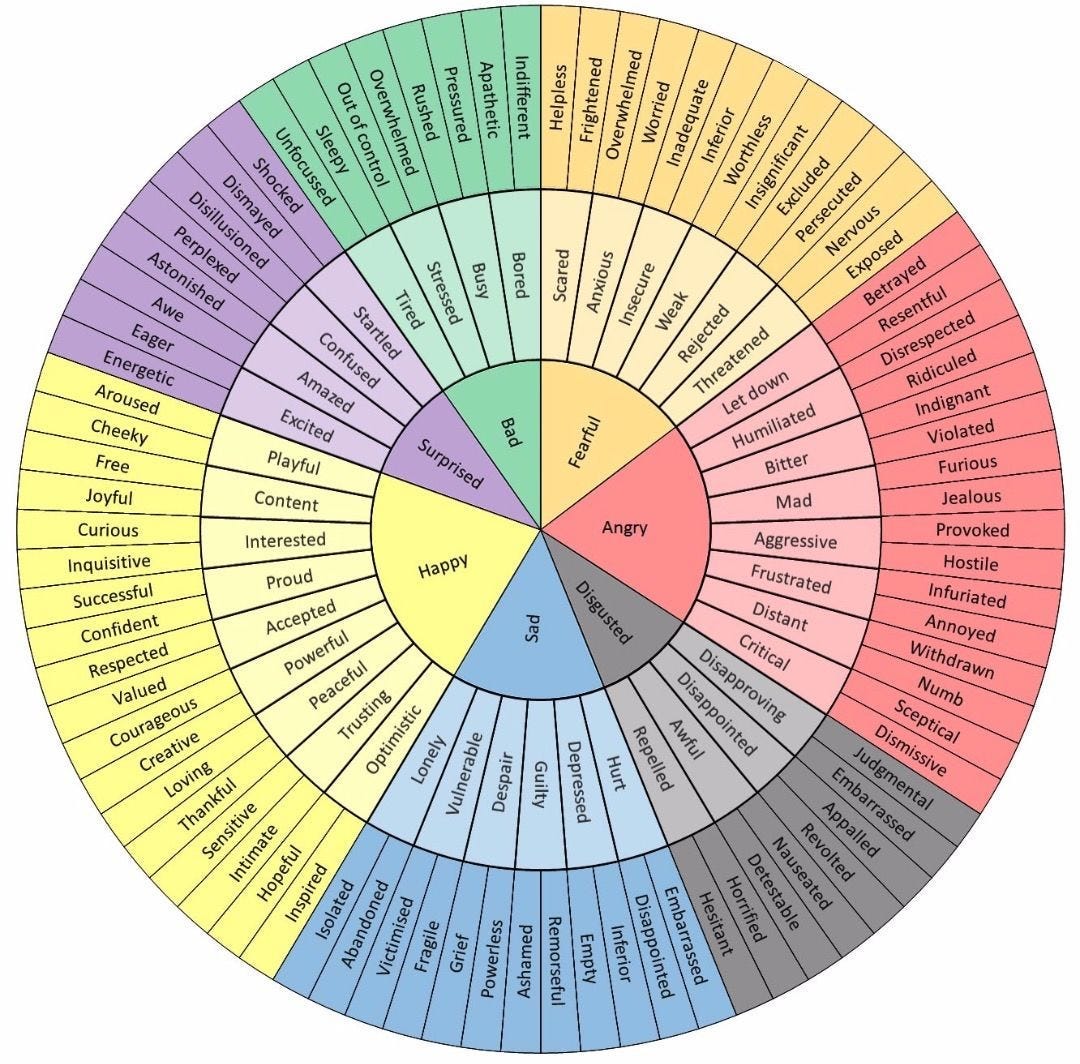
Neuroscience shows that naming your emotions helps move them through the limbic system into the prefrontal cortex, reducing their intensity. When you articulate feelings—grief, guilt, shame, relief—it activates the right ventrolateral prefrontal cortex, which helps regulate the amygdala, the brain’s fear and threat center. This process is sometimes called “name it to tame it.”
Use this emotion-wheel to help find the right word. Specificity deepens integration. The more precise the language, the more effectively the brain can process and regulate emotional experiences.
3. Find meaning in it
Writing about trauma is healing when we make sense of the experience, not just relive it. When you can integrate reflection alongside recounting. Answer these questions:
what did it cost you?
what did you learn?
how are you different now?
This activates the prefrontal cortex, helping reframe the experience and restore a sense of agency, sometimes referred to as “post traumatic growth.”
4. Make it private
At least initially, your writing is for you.
Let your nervous system trust that this won’t be exposed or judged. You might write in white text on a white background, size 2 font, or by hand and lock it away. Anything that helps you feel unobserved gives your subconscious more room to speak. In the wise words of Seane Corn, “you need to write everything but you don’t need to print everything” so create a writing practice that allows you to truly write everything.
5. Create writing rituals
You don’t need to push through when things are difficult. In fact, doing so can be counterproductive and can push us back into dissociation. So, if you find your heart racing or your mind-body connection shutting down, take a break. Write in short bursts. Stop when it feels too much.
In between writing sessions, actively nurture yourself. Watch something light, eat well, connect with someone safe. Healing through writing isn’t just what happens on the page—it’s how you take care of yourself around it.
If you struggle to think of something that feels nurturing (as is often the case for people who’ve experienced trauma), try returning to what brought you comfort as a child—or start here:
Listening to a nostalgic song on repeat
Doodling or coloring (no pressure to make it “good”)
Re-reading a book you loved as a teenager
Writing a thank you note to someone (alive or not, real or fictional, just express your appreciation)
I know that writing about our lives can be hard. And there’s a reason for it. Resistance, fear, even grief—they’re signs that the story matters. That it lives close to the heart of who you are becoming.
But not telling it comes at a cost, too. As Maya Angelou beautifully wrote, “there is no greater agony than bearing an untold story inside you.” When you resist sharing your truth, it doesn’t just weigh on the page—it weighs on the body. It weighs on the soul.
Writing won’t erase the past, but it can loosen its grip. It can offer shape to the formless, language to the unspeakable, and dignity to experiences that once felt unbearable.
You might wonder: Why bother?
Because, as Thomas Döherty’s poem of the same name reminds us:
Because right now there is someone
out there with
a wound in the exact shape
of your words.
Your story, as painful or difficult as it may feel, could be the thread that someone else holds on to in their darkest moment. It could give them permission to heal.
Trust that telling your story—on your own terms—is not only brave. It’s necessary. And in sharing it, you just might find the freedom you’ve been searching for all along.