
Outsourcing my self-worth
Why no one else can prove your worthiness

Stepping out of the car at 8:45am on Saturday morning I felt the feels of the first day back at school. Giddy with excitement and nerves of learning without screens. It had been a while. I was at Mesa Refuge—a writer’s retreat in West Marin—for a daylong workshop on honing voice and scenes in memoir.
The screen-less learning was made all the more delightful by the setting. We lounged around on armchairs and sofas in a cozy room with stacked library shelving around the back wall and an impossibly vast ceiling window on the front.
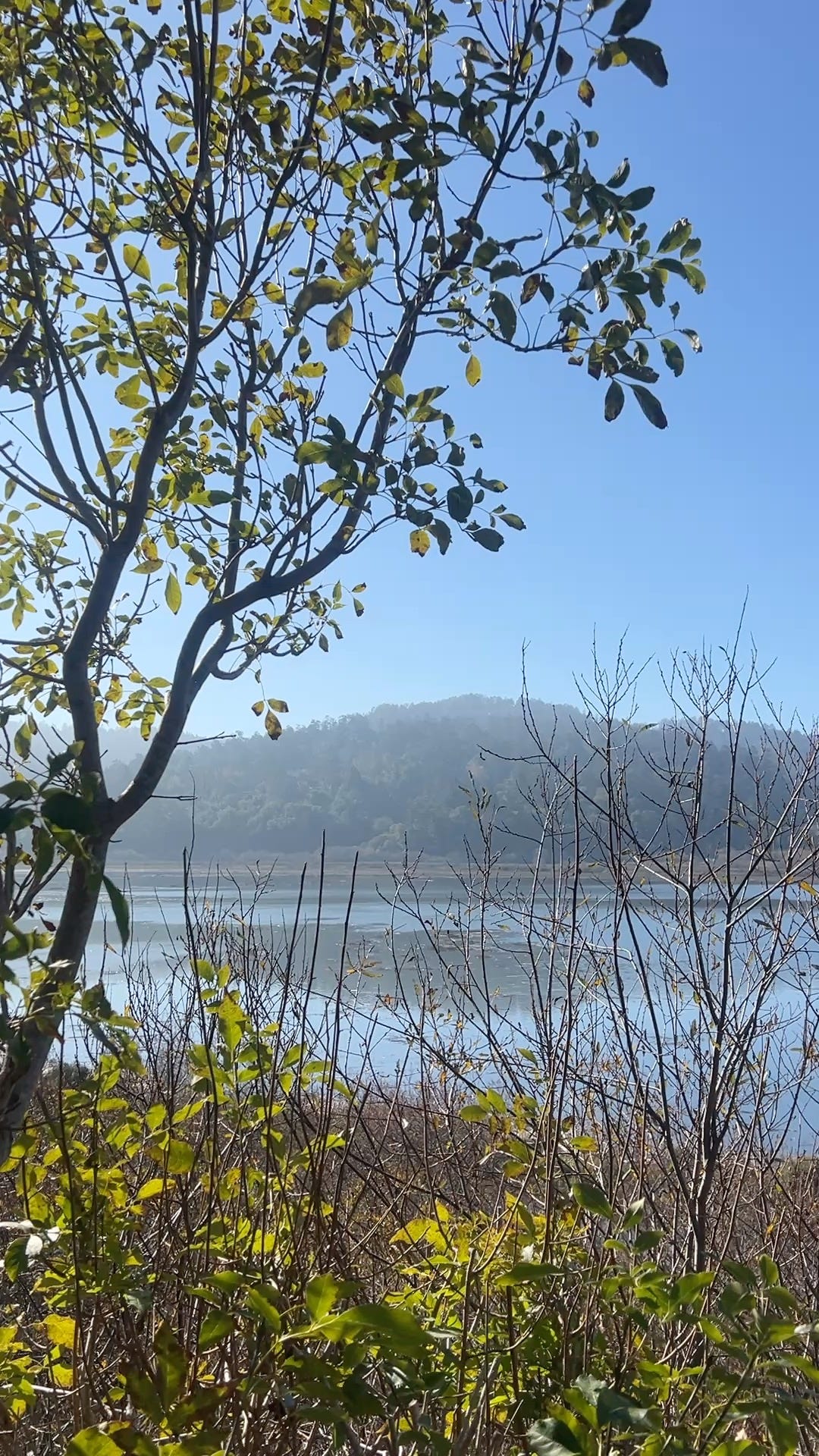
Beyond the window were winding paths to wooden writing cabins that dotted the hilltop, a steep cliff to Tomales Bay with its glittering water, and further beyond you could see the towering forests of the Point Reyes National Seashore. If you looked at the sky above you’d catch red tail hawks and bald eagles gliding by.
My fellow writers were a rag-tag bunch held together by a single thread that binds all memoirists—a determination to claim agency over the truth. Because as the teacher, Sunita Puri, put it “no one is here to write about how perfect their life has been.”
The day was split into two. In the morning we learned about “voice”, read a few excerpts, had some time to write, and shared our writing with the group for feedback. The afternoon followed the same sequence but focussed on developing “scene".
One of the participants was a woman, possibly in her 70s, who had been a mentee for the facilitator. Her writing was included in the list of excerpts and Sunita said of it, “this piece is perfect, there is nothing I would change about it.” I agree. There wasn’t a word out of place. It’s the type of writing that changes how you see the world from the moment you read it. Throughout the day I heard this participant’s feedback and reflections on other work. Similarly, each word she spoke was considered, precise, and value-laden. I decided that I wanted her to be my mentor.
I got home and Googled her name—the list of accolades and personal interests I found added to my desire. I started day-dreaming and fantasizing about the possibilities of my book’s success. With her as my mentor, I would get a book deal! I would have my words published in the New York Times! I would be seen and heard and valued!
I found her email address and wrote to her, asking if she would consider reviewing my first five pages. My email was gushy. Honest, but gushy. I shared how much I admired her work, words, and wisdom. How her writing has stayed with me and inspired my editing in the hours since the class. How grateful I’d be for her support.
Incredibly, she said yes. But she did so with the calm restraint of a measured professional. With no fan-fare or feverish delight. And it stumped me. I felt a wave of sadness and contraction. Usually I’d overcome this contraction with shame but this time, for some reason (growth, we can hope!), I got curious about it.
It dawned on me that although my email was asking for practical support, a small part of me was actually seeking something else. Something emotional. And when her reply didn’t match my neediness it left me feeling empty. This was a me problem. An attachment problem.
What I actually wanted but would never name was her approval, adoration, and unearned loyalty. And the reason I wanted it was because a part of me believed that if she approved of writing, adored my writing, and was loyal to my written word then it would prove that my writing is worthy and that I too, therefore, must be worthy.
Now that’s a big ask. And also, a futile one. Because I also know how my brain works. If she had replied with a gushing, wild elation I wouldn’t have trusted it. I’d have said to myself “this adoration is baseless!” “She’s clearly not very discerning!”
Just as someone, after a first date, might start dreaming about their future children’s’ names, I was outsourcing my future, my joy, my confidence onto someone else. And that’s never good. It reminded me that—try as I might—I can never find salvation in others.
My self-worth has to come from within.
Of course, I still want to work with her. To share my writing, get feedback, and learn from her. But I realized through reflecting on this little saga that the real work I have to do is not around improving my writing (that’s the easy part)—it’s believing in it. And maybe that’s the best lesson any mentor can teach.
I agree with this completely. What you named so clearly is the moment where learning shifts from skill to self-relationship. The longing wasn’t really for feedback or mentorship — it was for permission to believe in yourself. And noticing that, without collapsing into shame, is already a form of mastery.
From a Cognitive Transformational Mindfulness (CTM) (a form of mindfulness I have developed) perspective, this is exactly how self-worth matures. CTM doesn’t treat worth as something earned through approval or achievement, but as something restored when awareness stops outsourcing its stability. When we attach our confidence to another person’s response, we give them authorship over our inner life. Mindfulness, at its deepest, teaches us to take that authorship back.
Learning to master mindfulness really is like learning to live again because it changes where meaning comes from. Instead of chasing reassurance, awareness learns how to stay coherent in uncertainty — how to feel disappointment, hope, admiration, and vulnerability without handing them the keys to our value. Self-trust begins to replace fantasy. Curiosity replaces self-judgment.
So good <3