
Step-by-step guide to landing your book deal
Insider tips from a top literary agent, with examples.

In early August I attended Mendocino Writer’s Conference: a three day gathering hosted at my local K-12 school of authors, poets, and the people they most want to schmooze: literary agents.
The schmoozing was akin to the prepubescent flirtation you might see in the same classrooms but a few weeks later. Awkward, cringeworthy, and also somehow quite adorable.
I’d be lying if I said I didn’t partake myself.


The professional flirtation piqued during one afternoon class with Jessica Friedman, literary agent at Sterling Lord Literistic (who have represented some of my all-time favourite books including Tomorrow and Tomorrow and Tomorrow by Gabrielle Zevin; The Myth of Normal by Dr. Gabor Mate; and Know my Name by Chanel Miller).


Jessica’s easeful, candid, and fire-y presence energized me. “Agents really are just people, too.” I realized (duh!). And they actually have writer’s best interests at heart. We have aligned incentives and goals: a juicy book deal with a well-matched publishing house.
And to make that happen, here were the top tips I took away from the conversation.
Tip 1: Identify “Comparative Titles”
Start your process of landing a book deal by creating a map of the agents that have represented books in your niche. To do that, start by thinking of three or so “comparative titles” AKA similar books.
For example, for my upcoming memoir, Something Happened (working title) which is about generational trauma and neuroscience, I have started with:
What my Bones Know by Stefanie Foo
My Grandmother’s Hands by Resmaa Menakem
The Body Keeps the Score by Bessel Van Der Kolk
Once you have a few books in mind, you can use Amazon’s algorithm to your advantage.
Search for each of these books and then look at “Customers also bought or read” and “Customers who viewed this item also viewed” and “Frequently bought together.”
Doing so immediately gives you a handful more comparative titles to add to your list. For mine, these included:
Good Morning Monster by Catherine Gildiner
It didn’t start with you by Mark Wolynn
The Tell by Amy Griffin
Make sure you check the description of each of the books that you add to your list to ensure that they are in fact aligned. And remember, the comparative titles aren’t necessarily about the same event. In Jessica’s words: “look at books that have a similar style, not necessarily the whole book. For example, the humour of X meets the Y of Z.”
Set yourself the goal of finding 100 comparative titles.
Tip 2: Find the author’s literary agent
For each of the books on your list, find the literary agent that represented them. There are a few ways you can do this.
Google search “[Author’s name] literary agent”
Look in the acknowledgements at the end of the book. They will typically mention the agent. And if not, well, you probably don’t want to work with them anyway.
Sign up to manuscriptwishlist.com
Add all of these names to a spreadsheet and individually cross-check their agent profile on their agency website to check whether they are currently looking for the type of book that you are writing.
For example, I found the literary agent that represented Amy Griffin through Google searching “"The Tell, by Amy Griffin" literary agent.”
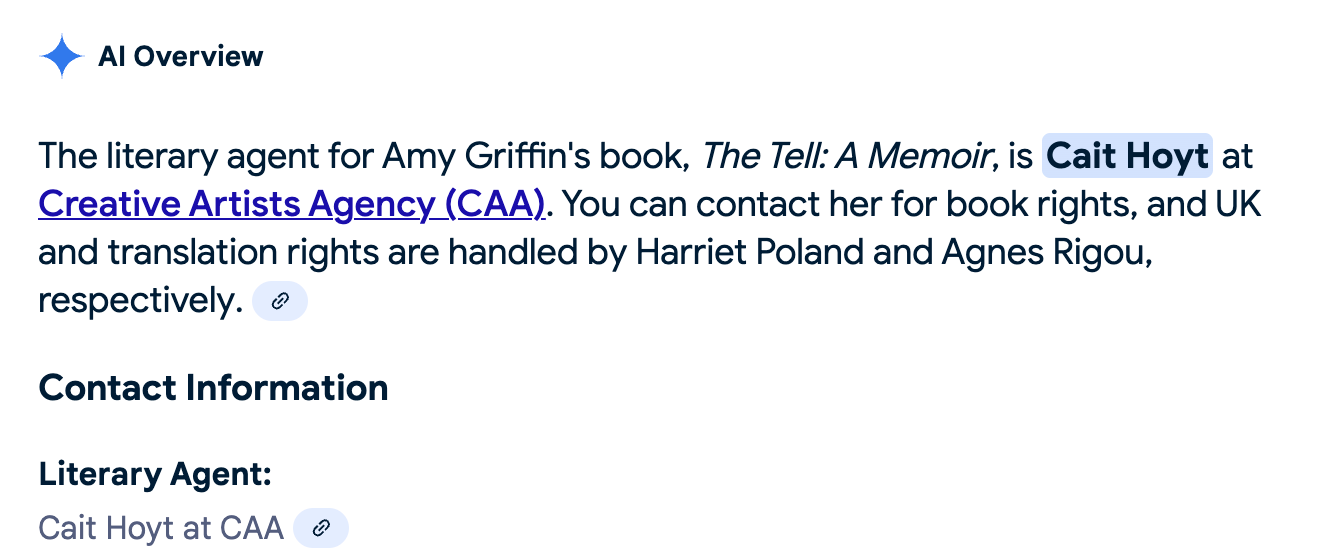
You can then look up the agent’s profile and determine whether they are looking to represent the type of book that you are writing.
As you’ll see below, Cait Hoyt focusses on authorship for “leading actors, musicians, journalists…” With that in mind, I would not query her. Because, for the record, I am not a leading actor, musician, or journalist.
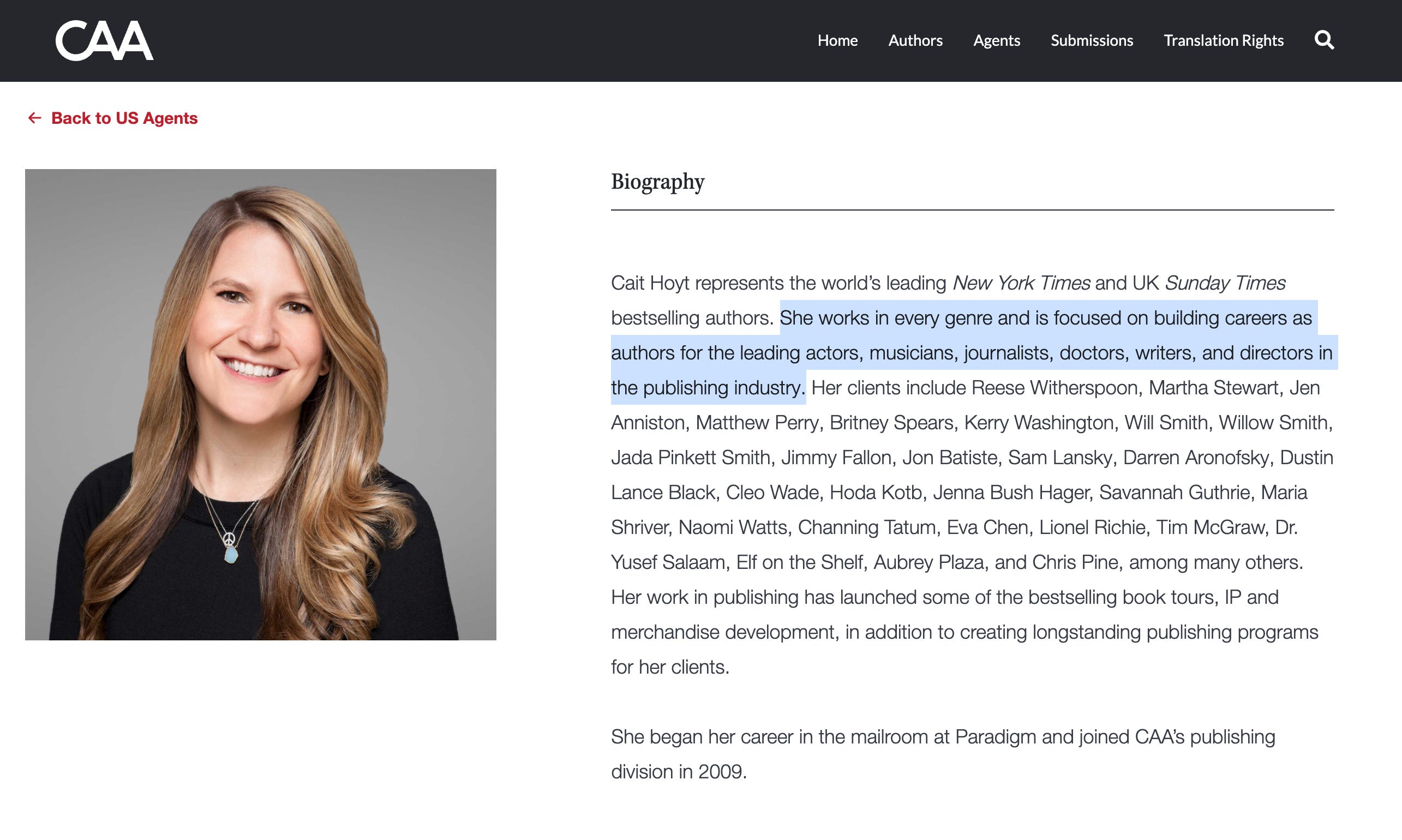
But, if her profile suggested that she was looking to represent authors like myself, I’d be able to get her email from the CAA website.
Tip 3: Craft your query letters
A “query letter” is essentially an email pitching your book to an agent. Jessica shared to watch out for the common traps with your query letter:
Don’t get too creative. The query should be perfunctory and succinct.
Make it personalized. Do not send out the same query letter to every agent.
Remember: do not query an agent who does not represent the type of work.
Review the agent/agencies specific requirements. Here’s an example.
Here is a simple template that Jessica shared for crafting your query letter:
Dear [correctly spelled name!],
[Section 1: why are you querying this person]
I am querying you because… [in this sentence or two, write either
you represented X and I loved it
you represented X and I believe that my upcoming book is in conversation with it
your agent profile mentions that you are looking for X]
[Section 2: about your book]
My upcoming book, [title], is about [describe your book in 1-2 sentences. Optionally, reference comparative titles].
[Section 3: about you]
I am [write a 1-2 sentence bio with relevant information only].
[Section 4: attachments/pasted below]
I have [attached/pasted below this email] [depending on the agent request, include relevant documents. At the query stage this might be the first three chapters. Word .doc is preferred, typically].
I look forward to hearing from you,
[Your Name]
Tip 4: Writing the ‘about your book’
For guidance on writing the short section ‘about your book’, Jessica recommended looking at the blurb of your comparative titles. This blurb can be found on the inside flap of hardback covers, the back page on paperbacks, or even in the Amazon description (although sometimes these can be wordy and tailored to SEO).
Here’s an example of a draft query letter I might use for my upcoming memoir querying Jane Dystel, the agent who represented Stefanie Foo (What my Bones Know: a memoir of healing from Complex Trauma).
I will be querying Jane specifically because
She represented an author writing in a similar style and about similar themes
In her profile on the agency website she explicitly states “I love to read …memoir, biography and history. I am very interested in current events, politics, legal subjects and women’s commercial fiction of all kinds. I find science fascinating and am passionate about science and medical narratives.”
Dear Jane Dystel,
I am querying you because of your representation of Stefanie Foo’s What My Bones Know and your interest in memoir, politics, and medical narratives — all of which coalesce in the core of my work.
In 2020, while living in Los Angeles, a stranger named Cat Daddy grabbed the belt of my jacket and told me, out of nowhere, that I’d been sexually abused as a child.
Something Happened (complete at 55,000 words) is a memoir about remembering what I had spent a lifetime repressing, confronting my family, and healing through everything from neuroscience and Lakota ceremony to meditating for 550 days straight and screaming into the redwoods. The book traces a journey from denial into confrontation, and ultimately toward integration.
It is a literary, trauma-informed, brutally honest memoir with moments of levity in the darkness. Think I’m Glad My Mom Died meets What My Bones Know and Fleabag.
I am the author of The Purpose Myth (self-published in the U.S. in 2021; traditionally published in Japan by Subarusya in 2022), which won the Business Book Awards in 2021 and was featured in Forbes and the Financial Times. I hold an MSc in Applied Neuroscience and write a weekly Substack (~2,000 subscribers) about trauma, memory, and the stories we’re told not to tell. Across social platforms, I have ~15,000 followers.
Per your submission guidelines, I have pasted the first 25 pages of the manuscript below.
Thank you for your time and consideration. I look forward to hearing from you.
Charlotte Cramer
Ensure that your query letter prioritizes matching the agency’s requirements and recommendations above all else. Although it will be time consuming, it’s worth it.
Querying can feel like awkward middle-school flirting all over again. But the only way forward is to show up and be respectful.
With the right comparative titles, an aligned list of agents, and a tailored and concise query letter, you’re not just tossing your book into the void. You’re starting a relationship that could change the course of your career (and even theirs!).